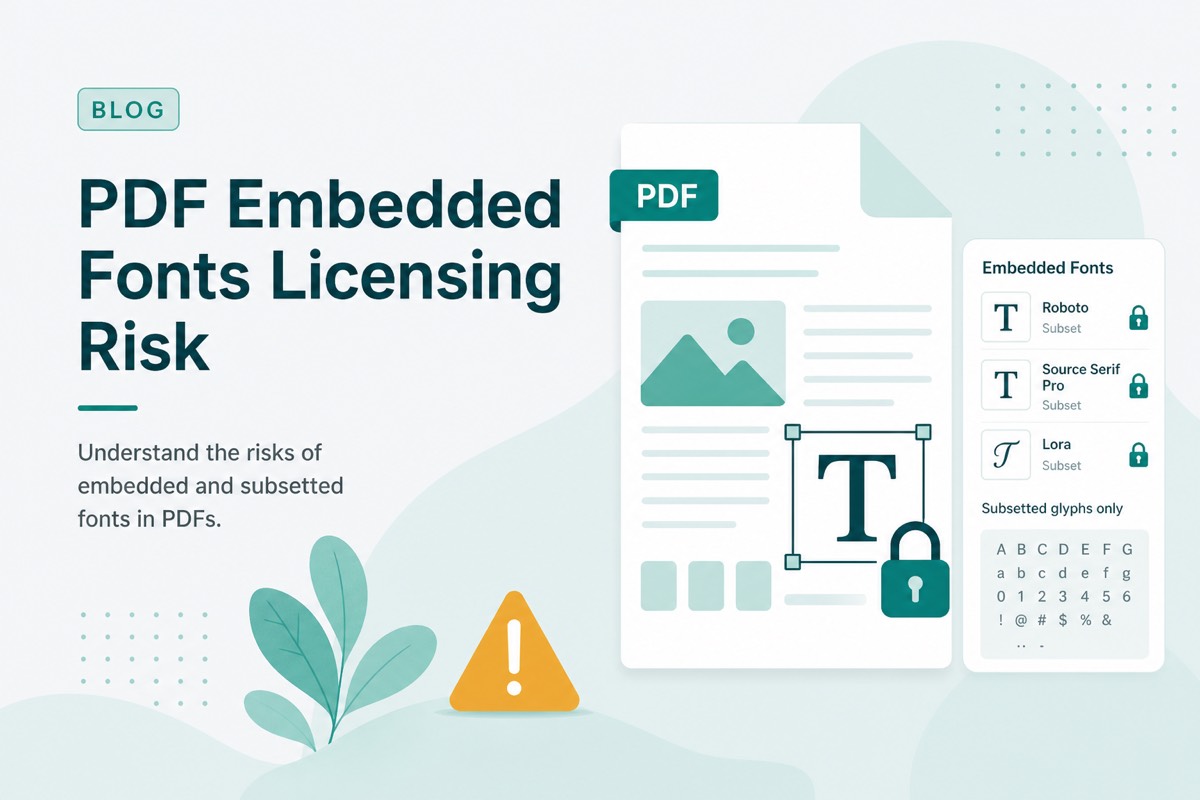
The Hidden Assumption
Teams often buy a web font license for the marketing site and assume every brand asset is covered. Then design exports a PDF with the same commercial family embedded. That PDF may need a different license type — desktop, electronic document, or explicit embedding rights.
Common Risk Scenarios
1. Web license, document embed
You licensed Helvetica for pageviews on brand.com. The sales deck embeds Helvetica Neue. Many EULAs treat PDF embedding as a separate use case.
2. Trial or “desktop only” fonts in client PDFs
A designer installed a trial desktop font, exported a PDF, and emailed it to 200 prospects. The trial never allowed redistribution via embedding.
3. Subset ≠ free pass
Subsetting reduces file size; it does not erase copyright. A subset of a commercial font is still that foundry’s product.
4. “Editable” vs “print/preview” embedding
Some licenses restrict embedding so recipients cannot edit text with the font. Others forbid embedding for public download entirely. Read the EULA language — it varies wildly by foundry.
5. Agency handoffs
The agency delivered “final PDFs.” The brand owns distribution risk. Contracts should require licensed fonts and delivery of proof.
What Foundries Care About
Enforcement for documents is less automated than website fingerprinting, but risks still show up when:
- PDFs are public downloads on your site
- Large enterprises negotiate enterprise font deals
- A competitor or ex-employee tips a foundry
- Due diligence in M&A asks for IP hygiene
How to Reduce Risk Without Killing Design
- Prefer OFL families for widely downloaded PDFs (proposals, public reports)
- Buy the right seat / document license for hero brand typefaces
- Outline text only when appropriate — logos/lockups; body copy that must remain selectable needs a real embed right
- Inventory quarterly — run PDF font audits on the marketing drive
- Separate libraries — “web only” vs “document / desktop” folders in your DAM
How Detection Helps
You cannot manage what you cannot list. Extracting embedded font names from PDFs turns a vague worry into a checklist: keep, replace, or license.
FontScanner can crawl linked PDFs on your website during a site scan and also accept a direct PDF upload for documents that never live on the domain.
Conclusion
PDF embedding is where brand typography quietly leaves the building. Treat document licenses as seriously as webfont pageview caps — especially for anything clients or the public can download.